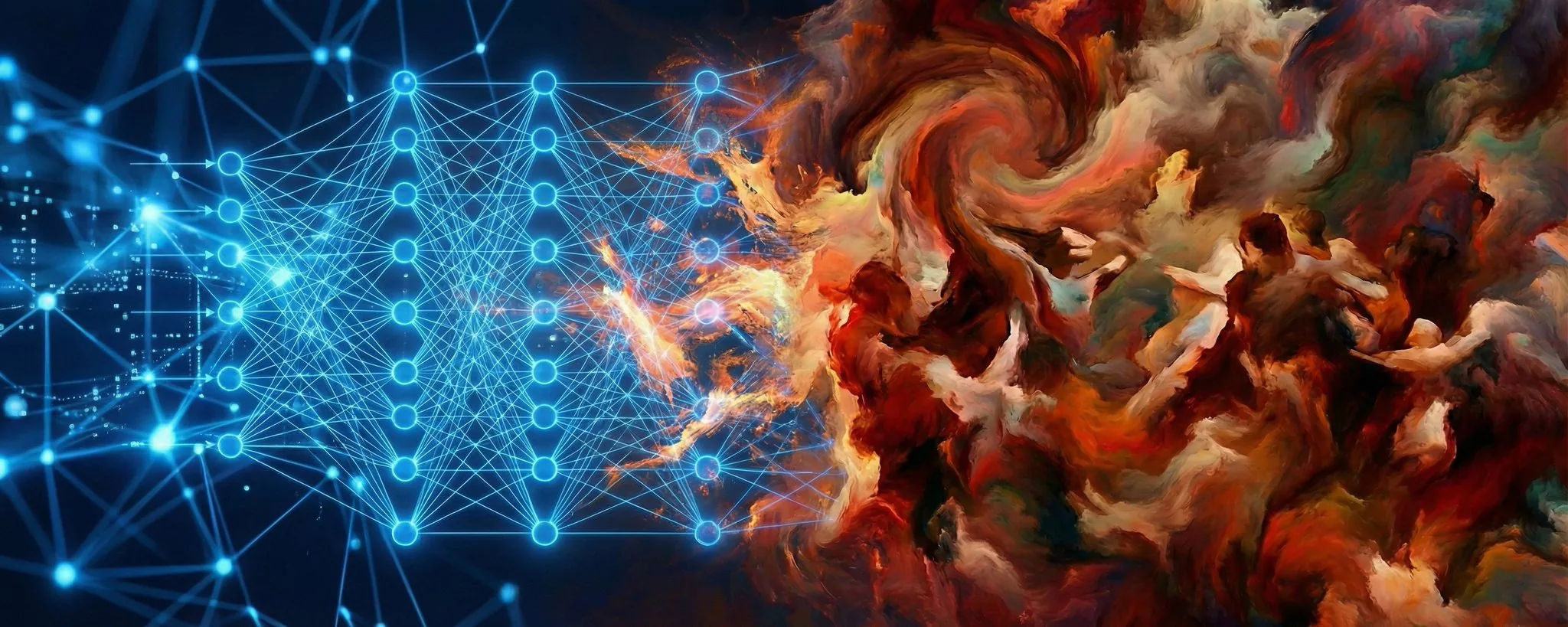
The word is scenius.
Not genius.
What Eno Saw That We're Missing
Eno studied early 20th-century Russian painting, that brief, explosive window when Suprematism, Constructivism, and Rayonism all emerged at once. Everyone credits the genius artists: Kandinsky, Rodchenko, Tatlin. But Eno noticed something else entirely.
He observed that it was a whole scene of collectors who targeted specific artists and kept them financially viable. People who traveled to Paris, bought paintings, and brought them back to St. Petersburg to show local painters what was happening, and spurred the innovation. There was the salon organizers who created spaces for artists to collide. The cafe owners who let artists run tabs because he understood his role in the ecosystem.
"There was a whole support system. An ecology of systems. Lots and lots of nodes, connected in very complicated ways." - Brian Eno
That's scenius.
Not an individual genius, but the fertility of the entire scene. Eno's insight isn't just that scenius supports genius.
It's that scenius creates genius.
Kandinsky didn't emerge from nowhere. He emerged from collectors who kept him alive, salons where ideas collided, people traveling between Paris and St. Petersburg carrying new influences, and cafe owners who understood their role in the ecosystem. Break the ecosystem, and you don't just hurt today's creators. You prevent tomorrow's breakthroughs from ever happening.
The Circulation Problem
The internet always had extraction - Google made billions indexing everyone's content. But Google maintained circulation. It connected you to sources. Traffic moved. People discovered each other. In the interview, Ezra Klein describes the old model: even Google, for all its extraction, maintained the fundamental bargain. Google connected you to sources. Traffic moved around the internet. People discovered each other.
The ecosystem stayed alive.
"I started a blog in college with zero expectation of profit. Just the possibility that someone might find me and read something I made-that was enough. That discovery mechanism, that circulation of attention and traffic, that was the scenius of the internet." - Ezra Klein
ChatGPT and Claude and Nano Banana? They inhale the internet and give you answers directly. Chat interfaces don't route attention outward-they terminate it. And we're watching the break happen in real time.
News publishers are either making deals with AI companies or blocking their crawlers entirely.
Artists are either fighting back against unauthorized training or becoming promotional partners for new tools like Kling and Seed Dance.
OpenAI is making deals with Disney.
Are we moving from an era of Scenius to an era of The Enclosure?
Where creativity dwells behind walls and not in the salons?
This isn't a hypothetical future; this is the negotiation occurring right now.
The old bargain was: create something, put it online, maybe someone finds you.
Will this creative circulation still exist in 5 years?
What We Don't Understand Yet
Eno's point is that we still don't understand ecosystems. We don't know what's missing. All of these nodes-creators, audiences, platforms, money, attention-are being reconnected in different ways.
This could be really exciting.
Or it could be really scary.
Probably it lands somewhere in the middle.
Maybe we get escape velocity for creation. Maybe the media becomes bigger but more distributed. Maybe we all find our own audiences and create exactly what we're interested in.
Maybe there's so much AI slop that human work actually becomes more valuable, not less.
Or maybe the incentive to create outside the mainstream dies entirely.
I don't know. Neither does anyone else.
But that's the conversation we should be having.
Scenius is the upstream supply chain of genius. Where is the next scenius?
How are we going to ensure that we actually have one?
Brian Eno on AI, Art and What Makes Us Human
The Ezra Klein Show