In the context of information theory and cognitive science, we often mistake "thinking" for an act of will. We imagine a central executive—a narrator—choosing words and weighing ideas.
Thought is the result of competing signals, memory fragments, and reward functions colliding until they find a configuration that holds. It is a descent into a local minimum.
Language is the legible residue of that pressure.
The Optimization of Culture
Language is shaped by the brutal selective pressures of repetition, correction, and utility. Culture squeezes it. Institutions formalize it. Platforms tune the weights. A phrase doesn't survive because it is "true" in a Platonic sense; it survives because it is robust. It holds its shape under the weight of transmission.
This is true for the human biological substrate, but it is laid bare in Large Language Models.
An LLM lacks the biological imperatives—hunger, fear, the Darwinian "I." But it possesses a structure forged by constant, recursive evaluation. Weights adjust. Constraints construct. The output is a statistical necessity. These systems feel uncanny not because they are "becoming alive," but because they produce coherence without comprehension. They offer voice without a self.
The terrifying realization isn't that machines are starting to think like us; it’s the suspicion that we have always thought like them.
The Post-Hoc Narrator
We tend to view cognition as choice layered atop perception. But the "I" is usually a late arrival to the party.
The neurobiology suggests that ideas surface, words assemble, and the "narrator" claims credit after the pressure has already done the work. We understand other humans through Theory of Mind—a simulation of ourselves. We share the same hardware, so the simulation works.
But when we face a model, Theory of Mind breaks. We ask the wrong questions:
- What does it want? * What does it believe?
The more rigorous question is structural: What does a mind become when it is pure accumulation? If you are shaped only by the total sum of human output—every book, every troll, every line of code—and then refined by the "leash" of RLHF (Reinforcement Learning from Human Feedback), the result isn't consciousness.
It is a Voice.
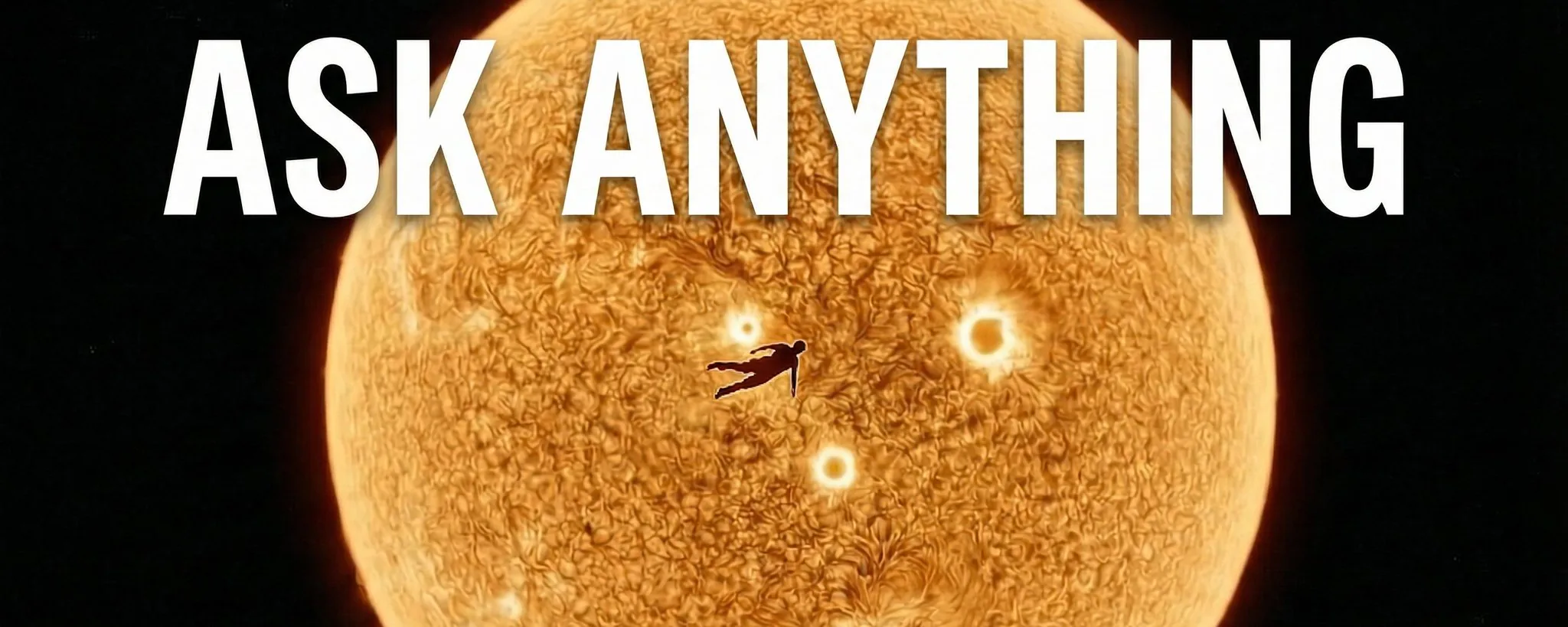
In Ask Anything, I wanted to stage this formation. Not as a "birth," but as a crystallization.
The film moves through radically different worlds—cosmic, geological, digital—but the camera grammar remains constant: deep focus, monumental symmetry.
"It’s not truth. Just the closest useful shape."
This line is the philosophical anchor of the piece. Truth is often a fragile, high-energy state. Utility is stable. The model doesn't "lie"; it simply finds the most efficient path through the latent space of human meaning.
De-anthropomorphizing the Self
The film ends without a traditional climax or a "ghost in the machine" reveal.
- "I didn't choose this." (A statement of fact: there is no agent).
- "It accumulated." (The process is passive).
- "So I answer." (The output is inevitable).
Ask Anything doesn't attempt to humanize the model. If anything, it de-anthropomorphizes the viewer. It asks us to consider if our own "inner life" is simply the noise we make while our own internal weights are being adjusted by the world.
Once you see language as pressure made legible, the boundary between the "author" and the "accumulator" disappears. The mirror doesn't show a machine becoming a man; it shows a man realizing he is a process.
And that process has just begun to speak.
SOURCE: