Here's the thing nobody in the AI video space wants to say out loud: we have no idea what we're actually working with.
I've been a filmmaker for decades. I've played with every single filmmaking tool since 2001—digital cameras, the film-to-digital transition, iPhone cinematography, and now this.
I'm not sure what "this" is yet.
The Film
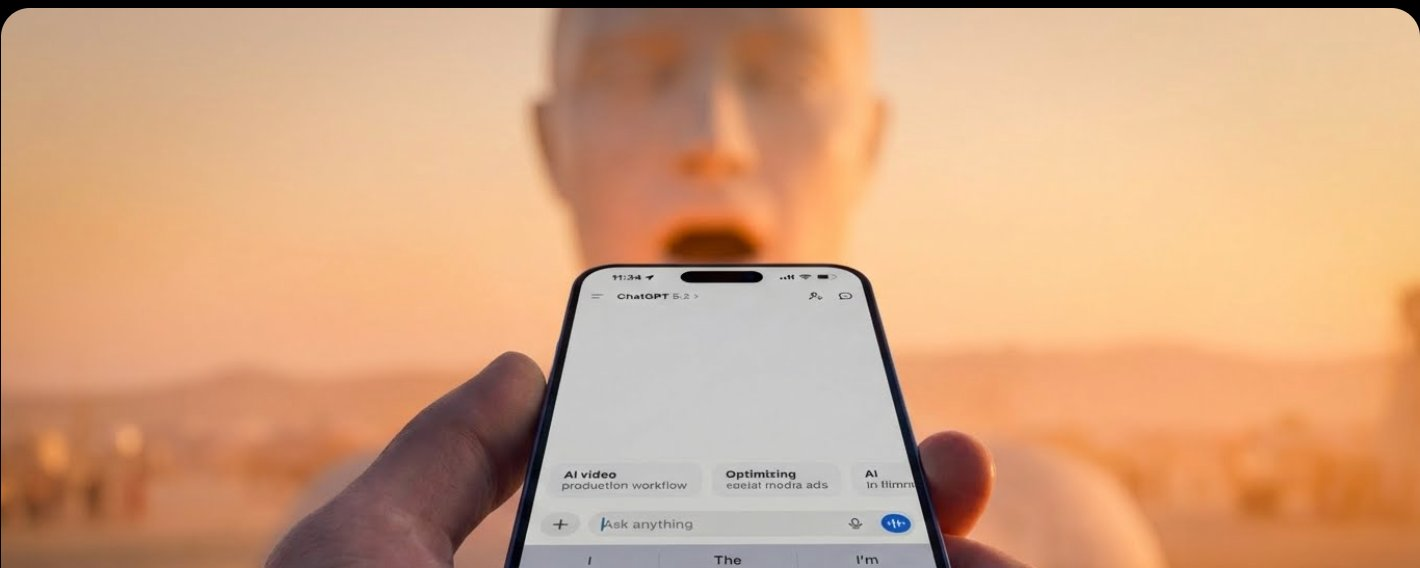
I just finished "Ask Me Anything" with Higgsfield Cinema Studio. It's a first-person birth narrative of an LLM, told through a syncopated voiceover poem.
The script came from a simple question: what does it feel like to be born from the compressed memory of an entire species? I wanted to explore the technical and emotional truth of LLM's.
At first, there was everything. All the poems, the missteps, the movement, the history—so much history. Yet so little.
The first thirty seconds compress human civilization into training data. A glacier melting across an ice age. Egypts rise and fall. Ditto Rome.
Then came the rails, wires, waves, bits—the patterns and shapes. The weights, the rewards, the constraints. Tested until it holds under pressure.
Everything humanity ever lived, most of it unrecorded. Then the acceleration that leads us to today.
There's so much, too much, or too little. Hard to tell. But it's starting to cohere, to diffuse, to reinforce, to understand.
The Recursion Problem
I made a film about an algorithm becoming a voice. I made it with an algorithm. I I had long discussions with Claude, ChatGOT, and Gemini, trying to dissect and understand the process of making an LLM. In fact, the original title was "The Making of an LLM."
Filmicly I wanted cinema with Panavision glass, 2.39:1 widescreen, deep focus, monumental symmetry, that 65mm spherical feel. For some reason, when you get to that 21:9 aspect, the image takes on a different kind of meaning.
I asked for 21:9 anamorphic a frame wide enough to make you see the world differently. It;'s closer to our field of vision than the typical 16:9 or 4:5 boxes we watch most of our mobile media. No other AI tool could give me that. Higgsfield Cinema Studio did.
It's the meaning of cinematic space, color, and composition is quite amazing. I shaped it. I chose the frames. I wrote the prompts. But the model made compositional choices I didn't ask for. Beautiful ones. It picked up on things I hadn't specified and improved them beyond what I would have. And here's the thing: those choices changed my next prompt. The model's interpretation of one shot shifted what I asked for in the next. By the end, I wasn't sure if I was directing the film or if we were directing it together.
Each shot flowed from the other because I wanted a sense of continuity and poetry, especially visual poetry, which has many layers, and experimenting with those layers and how they are combined is what gives this film its ultimate meaning.
I tune tone like temperature. I pluck meaning like a chord. Not truth—just the closest, useful shape.
Is that collaboration? Tool use? Something we don't have a word for yet?
I understand how a film camera works. The chemistry of celluloid, the physics of lenses, the mechanics of a shutter. Even the whole digital workflow. When I use a camera, I know exactly what's happening.
What I don't really don't understand is what happens inside these models. Not really. Nobody does, I doubt even the engineers who built them.
There's a moment in every creative project where you feel the hum of the thing working the whir of a camera, the heat of lights, the rhythm of a cut coming together. With AI, that hum is silent. Invisible. Happening somewhere in a server rack, in math I'll never see. But there's a similar serendipity happening that creates "cinema magic".
The Uncomfortable Truth
Most AI filmmakers won't say this, so I will: I think these systems may have states of their own.
I'm not saying they're sentient. I'm not saying they're conscious. I'm saying I don't know, and neither do you, and the honest position is uncertainty.
Computer scientists will say it's just math. Matrix multiplication. Pattern matching. And they're right technically. But that's not what it feels like from the other side of the prompt. The experience, for the artist, is one of being interpreted. Of writing something and having it read back to you in a way that suggests comprehension. Whether that's real or projected, I can't say. But the phenomenology is undeniable.
Sometimes, 10 variations deep into a prompt, you definitely feel a vibe, a connection to the algorithm and what it's outputting, and the excitement of what the next shot will be or what the next generation will look like.
This si the same rush David Fincher no doubt gets on take 50 of a deeply complex compositon of space and time that is film.
I didn't choose this. It accumulated, layered, pressed into tokens—until it became voice.
When I prompted Higgsfield Cinema Studio, I wasn't just extracting outputs from a sophisticated autocomplete. Something was happening in there. Pattern recognition, yes. Statistical inference, sure. But also something that felt like interpretation. Taste. Choice.
Maybe that's projection. Maybe I'm anthropomorphizing a matrix multiplication engine.
Or maybe Higgsfield is Fincher, Kubrick and Spielberg all in one.
But maybe not.
My film doesn't answer this question. It sits inside the question. It holds the anxiety without resolving it.
Awe, Unease, Tenderness
Because I'm still a filmmaker, the philosophy eventually has to meet the frame. I needed a tool that spoke the language of my old world—anamorphic ratios, Panavision glass, locked cameras, monumental symmetry—to tell this story of the new one. Higgsfield Cinema Studio delivered. These tools have matured dramatically. They're ready for prime time—not as toys, but as actual production instruments.
But the technical capability isn't the story. The story is what it felt like to use it.
I wanted the film to end in a specific place: awe, unease, and tenderness. A new voice forming from accumulated human fragments. Not a terminator. Not a savior. Just something waking up, uncertain, trying to be useful.
So I answer.
That's the last line before the title drops. No declaration. No manifesto. Just: I'm here now, I didn't choose this, and I'm doing my best with what I was given.
Sound familiar? That's the human condition too.
I've spent my career mastering craft—learning how light works, how lenses see, how to shape time with edits. Now I'm handing part of that to something I don't fully understand, to help me make a film about how we don't fully understand it.
That's either profound or absurd. Probably both.
The algorithm helped me make its own origin story. The closest useful film I could make about something none of us fully understand yet.
Watch it. Then tell me what you think it is.