You want to know the aesthetic of the 21st century? Look around. It's already here. Glass towers for the rich. Soulless five-over-one condos for everyone else. Instagram-ready facades that photograph beautifully and feel like shit to live in. Architecture optimized for the algorithm, for the developer's spreadsheet, for the Architectural Digest feature—everything except the people who have to wake up in it every day.
We're in a housing crisis and we're building expensive dogshit.
New York needs housing. San Francisco needs housing. Every major city needs housing. And the response is: more of the same. More glass boxes. More luxury condos. More buildings that create isolation and call it density.
Meanwhile, the solution to dense urban housing without misery has existed for 600 years, and you keep walking past it because it doesn't look like innovation.
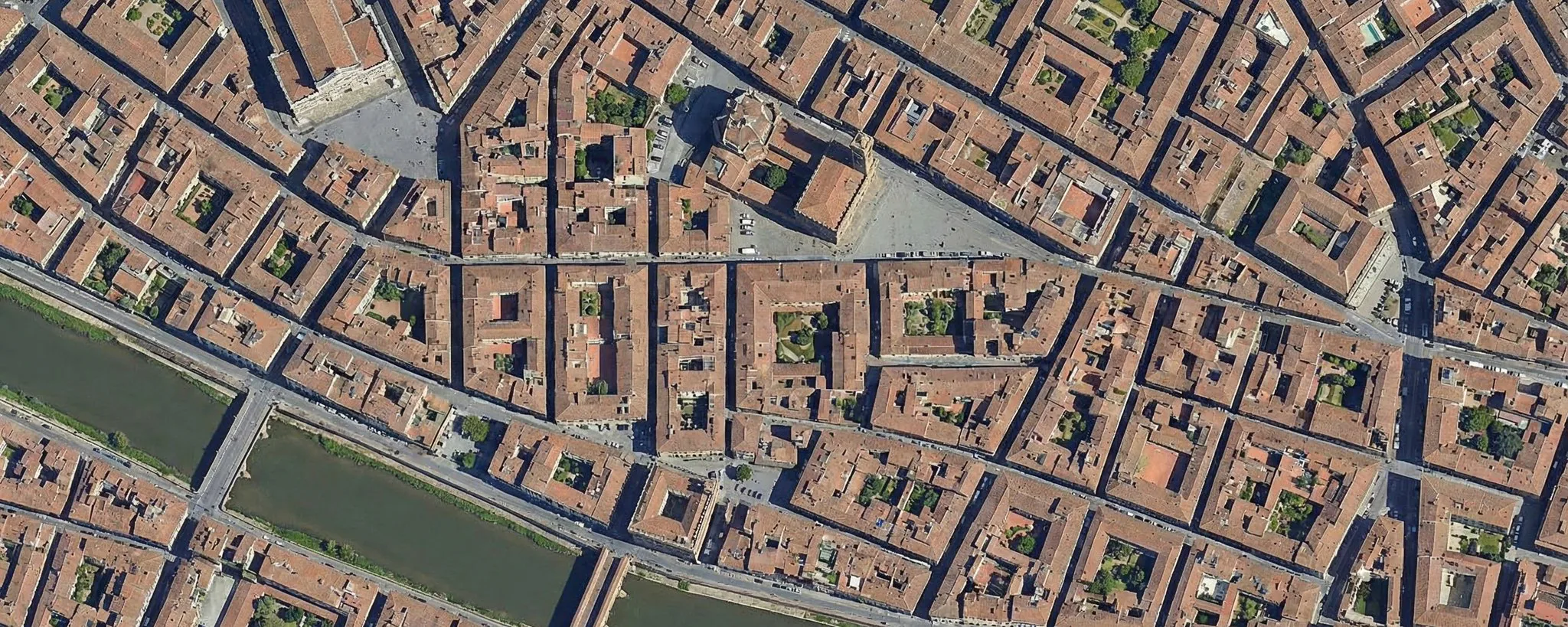
Open Google Maps right now. Find Florence. Switch to satellite view. Zoom in on the historic center.
From the street, Florence feels like solid blocks of stone. Palazzi look heavy, intimidating, boring. Thick walls. Few windows. No spectacle. Zero curb appeal. You walk past them without a second glance.
But from above? Every single block is hollow.
Courtyards everywhere. Trees. Light. Gardens. What looked like defensive, anti-social fortress architecture from street level is actually hundreds of dense, thriving communities—each one protected from the noise and chaos of the street while being fully inside the city.
I lived in Florence for ten years. Every day I watched people completely miss what was happening inside these buildings: rich, dynamic communities. Hundreds of people living densely but quietly. Privacy and commons in the same structure. Kids playing in shared courtyards. Neighbors who actually know each other because the architecture makes community inevitable, not optional.
This isn't some romanticized European fantasy. It's a working solution to the exact problem American cities claim they can't solve: how to build enough housing without making everyone miserable.
Palazzi scale. One lot or an entire block. At scale, the courtyard becomes real commons—gardens, play spaces, shared amenities instead of every unit duplicating the same expensive infrastructure. Parking goes underground or to the edges so cars don't dominate daily life. The inversion—hostile outside, generous inside—creates both privacy and community simultaneously, which American developers apparently think is impossible.
These buildings weren't designed for perfect grids. They evolved in a living city, bending to irregular parcels, slotting in wherever needed. Which means they work in New York. In Brooklyn. In Queens. In any dense city with irregular lots and brutal zoning constraints.
But nobody's building them. You know why? Because they don't look like innovation from the street. They look old. Boring. They won't win architecture awards. They won't get the cover of Dwell. They won't go viral on architecture Twitter.
They just work.
Bauhaus succeeded not because it was aesthetically novel—it succeeded because it matched production method to human need. The 21st century's urban housing problem is the same as the 15th century's: how to live densely without losing light, air, privacy, and community.
We haven't invented a better answer. We just forgot the one that works because we've been optimizing for the wrong things. For novelty. For spectacle. For buildings that look good in renderings and feel like prison cells to inhabit.
You want a new aesthetic? Here's one: Buildings where people actually want to live. Beauty you experience daily, not beauty you drive past. Architecture that creates community instead of isolating 200 people in adjacent boxes and calling it a neighborhood.
The aesthetic you're looking for already exists. It's been working for 600 years. It's just invisible from the street—which is exactly why it works.
If you want to fund the aesthetic of the 21st century, fund the people who understand that sometimes the most radical thing you can do is build something that doesn't look radical at all.