01 / Audit
List what cannot move.
Proportions, compartments, modules, cables, vents, colours, placards and weights became the fidelity checklist.
Gelion / Product visualization
Gelion needed photoreal product imagery for a certified containerized battery system. Every module count, cable, compartment, placard, weight, colour and proportion had to remain true.
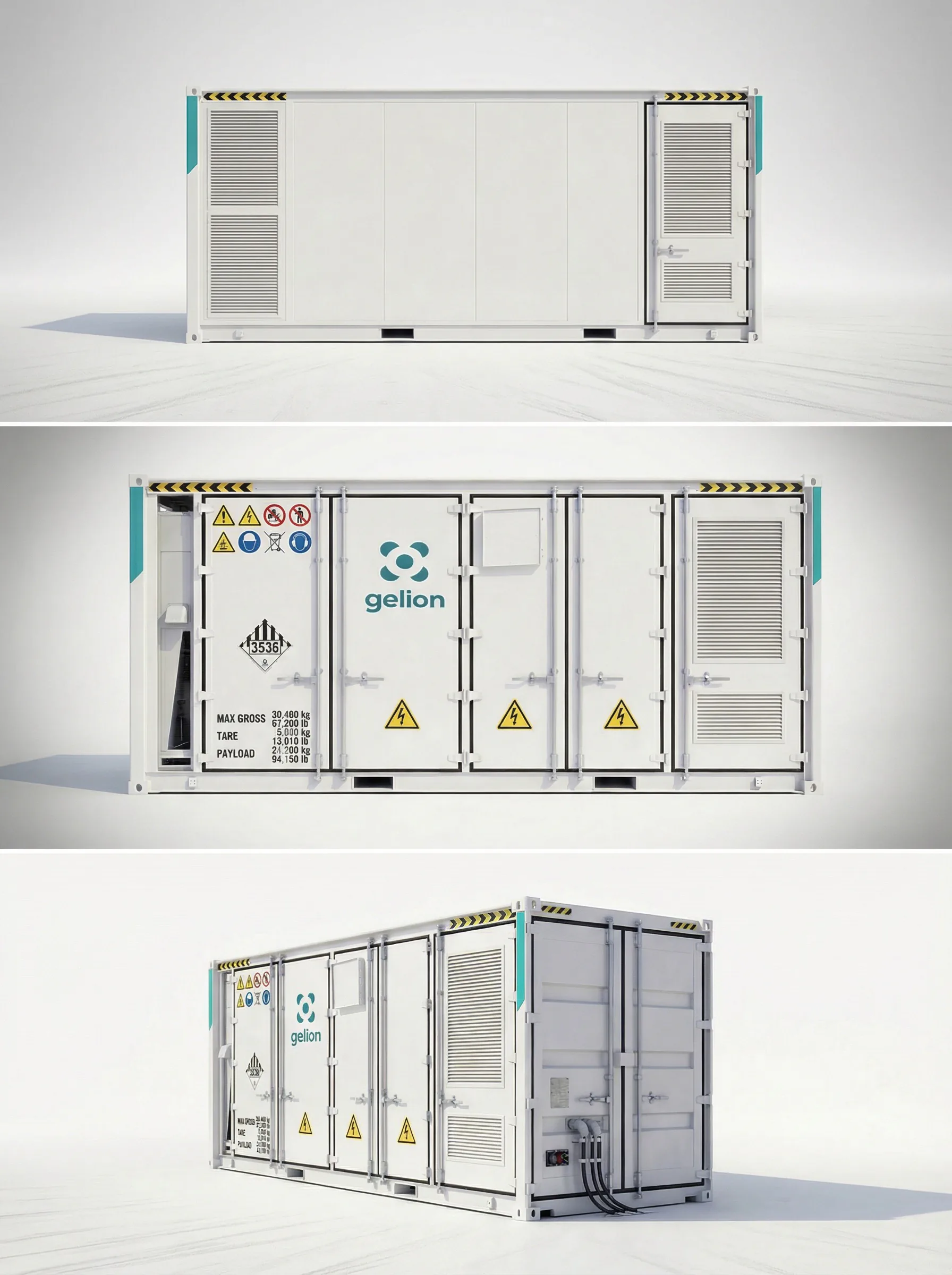
Gelion / locked product views
What our lens uncovered
The task was not to imagine a better-looking battery system. It was to make the real one cinematic without changing what it was.
01 / The assignment
A single reference image was not enough for a model to understand the whole product. Each new angle invited it to simplify vents, move doors or invent hardware.
We separated the problem into two stages: lock the container in isolation, then move that approved product into new environments.

02 / The creative decision
Trying to solve product and environment at the same time created drift. Once the container itself became a stable reference, lighting, location and camera could change around it.
New context. Same certified product.
03 / Building the imagery
01 / Audit
Proportions, compartments, modules, cables, vents, colours, placards and weights became the fidelity checklist.
02 / Lock
Isolated views removed environmental noise and created one clear visual authority.
03 / Place
Only after approval did we explore context, light, angle and scale.
04 / Visual Intelligence
A serious energy product shown with the clarity of an engineered system.
Precise, modern and unembellished.
Technical credibility begins when the image survives expert inspection.
Confident enough to be simple; detailed enough to be trusted.
Clean light and controlled space made the industrial object easy to read.
The real container, markings and Gelion palette became the reusable center of every scene.
05 / The role of AI
Generation was useful only after the product had been made authoritative. The reference system, fidelity checklist and compositing process prevented the model from quietly redesigning certified equipment.
06 / The result
Gelion gained a flexible visual product foundation that could support new contexts while keeping the container’s certified construction recognizable and intact.
Deeper questions
We isolate and lock the product first, define the non-negotiable details and review every output against the same authority. Environment and lighting are creative; certified construction is not.
Because each additional variable gives the model another reason to drift. Separating product fidelity from scene design makes correction visible and repeatable.
Yes. Once the product reference is stable, it can be placed into new industrial, editorial or campaign contexts without starting the accuracy problem again.